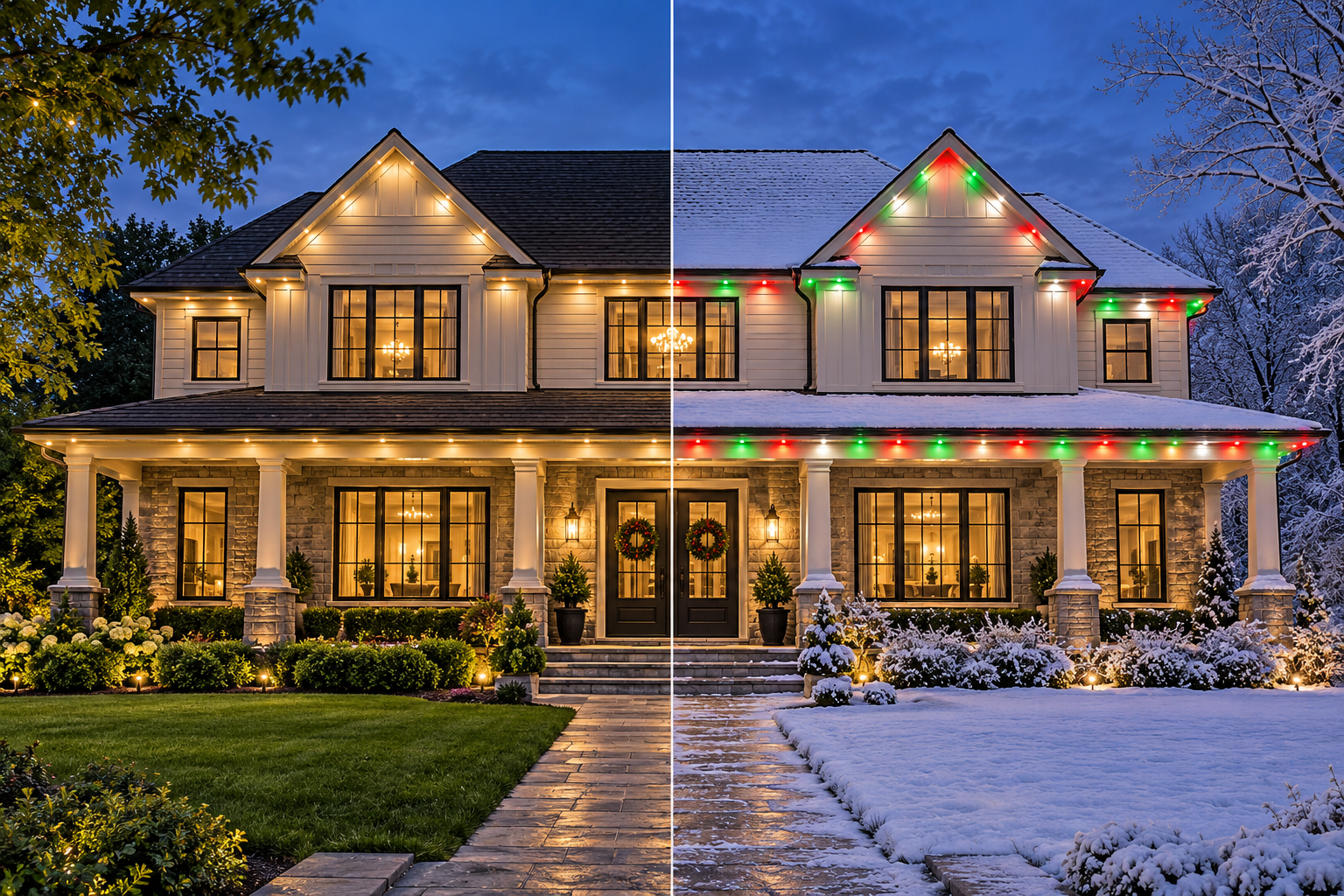
Two systems can both offer millions of colors and still deliver very different installations. When comparing a big-box permanent lighting kit with a professionally supplied system, look beyond the app effects to how the lights fit your home, how they look in daylight and who will support them.
A retail kit may suit a homeowner’s weekend DIY project. Paying a “company” to install that same kit does not, by itself, turn it into a professional-grade system. Before paying professional installation prices, look for a custom mounting plan, a clean daytime finish, a practical repair path and a real business willing to put its responsibilities in writing.
We do not install Govee or customer-supplied big-box lighting kits. We supply our own permanent lighting systems with custom layouts and concealed aluminum tracks. In our view, a “company” presenting a consumer retail kit as a premium professional system is a red flag worth investigating before you commit.
Start With Your Roofline, Not The Box Length
Homes have gaps between sections, changes in height, corners, dormers and areas that should stay dark. A kit’s total footage does not tell you whether it can follow all of those features neatly. Check permitted cuts, extension lengths, connection limits and the maximum supported system length.
Retail products differ. For example, Govee’s Permanent Outdoor Lights Pro supports cutting and extension subject to its instructions. It would be inaccurate to say all consumer kits cannot be customized. The question is whether a particular model fits your layout within its documented limits.
Our design considers the entire route before installation: where light is wanted, how unlit transitions will work, where power is available and how the sections will be controlled. That planning becomes more important on taller or more complex homes.
Preset Lengths. Hidden Splices. Long-Term Consequences.
Retail kits come in preset lengths, and some are not designed to be cut. Cutting a non-cuttable set to fit a roofline can damage the system and may jeopardize warranty coverage for the modification or resulting damage. Check the exact model and warranty before anyone cuts it. Govee’s standard RGBIC and Outdoor Lights 2/Elite models are not cuttable; Pro and Prism models allow cutting and splicing under their instructions.
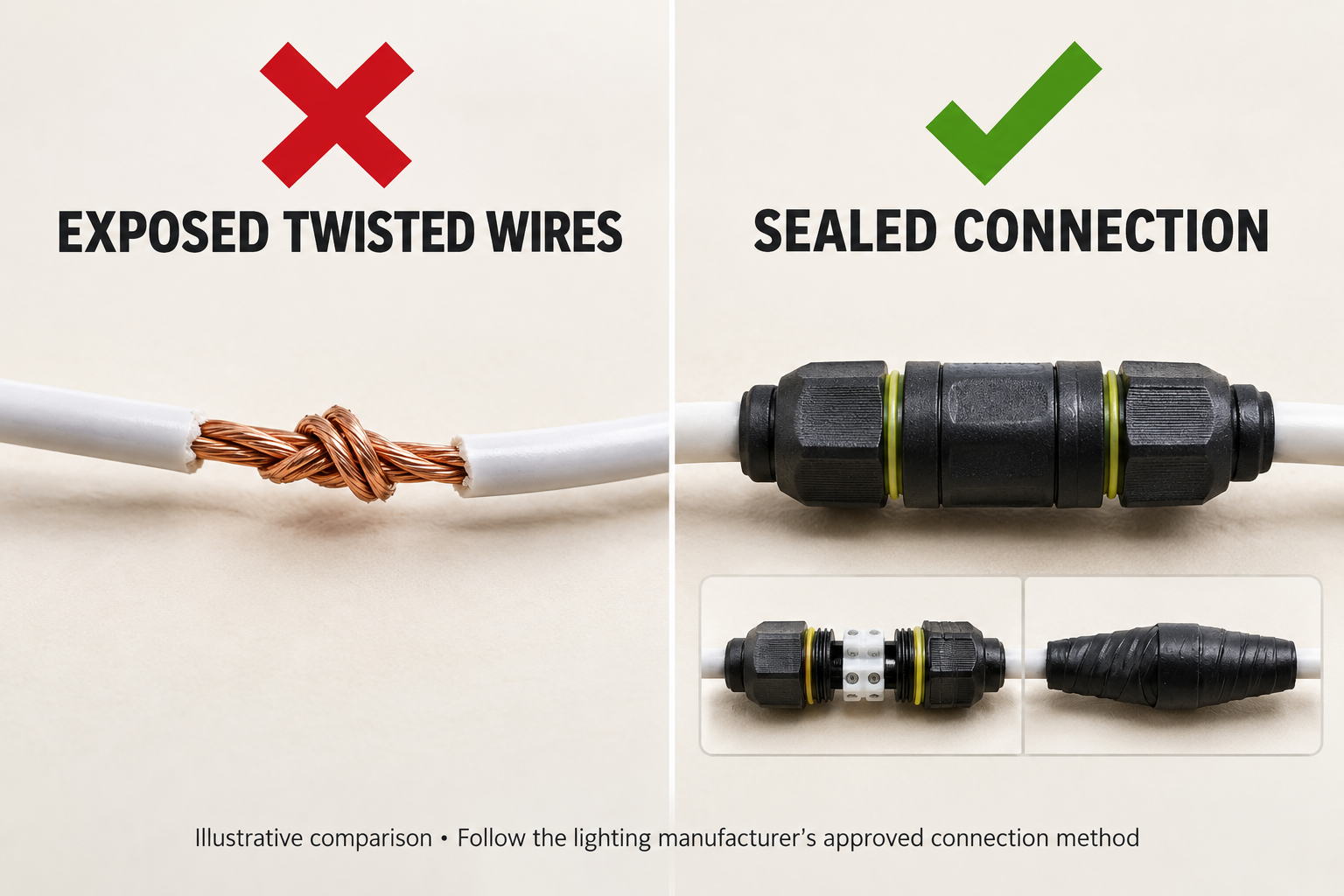
A working splice is not necessarily a weather-sealed splice. Simply twisting bare wires together leaves the connection unprotected. Even beneath a soffit, humidity, condensation and wind-driven moisture can reach an inadequately sealed splice or cut end. Corrosion can develop over time, causing intermittent operation or premature failure without an obvious soaking.
Transitions, splices and end terminations need the lighting manufacturer’s approved connection method, compatible outdoor-rated connectors and the specified seals, caps or weatherproofing wrap. Ordinary tape alone is not a substitute for a properly rated, sealed connection. Ask your installer how every modified connection is protected and whether the modification is permitted.
More Than A Failed Light: Safety & Insurance
Poor electrical connections can overheat, and exposed conductors or damaged insulation can allow short circuits. Depending on the equipment and fault protection, these faults can create a fire risk. Low-voltage lighting still needs correctly rated components and sound connections; a bare twist is not an acceptable finished outdoor splice.
Verify insurance before work starts. Ask for the installer’s legal business name and proof of current liability insurance, and confirm with the insurer or agent that the planned work is within the policy’s scope. If a contractor has no insurance—or will not provide proof—treat that as a serious red flag. Do not assume a product warranty covers installation damage, or that a retail-kit installer is insured simply because they advertise as a professional.
Manufacturer cutting and splicing guidance · Why splice sealing matters
The Daytime Finish Is Part Of The Product
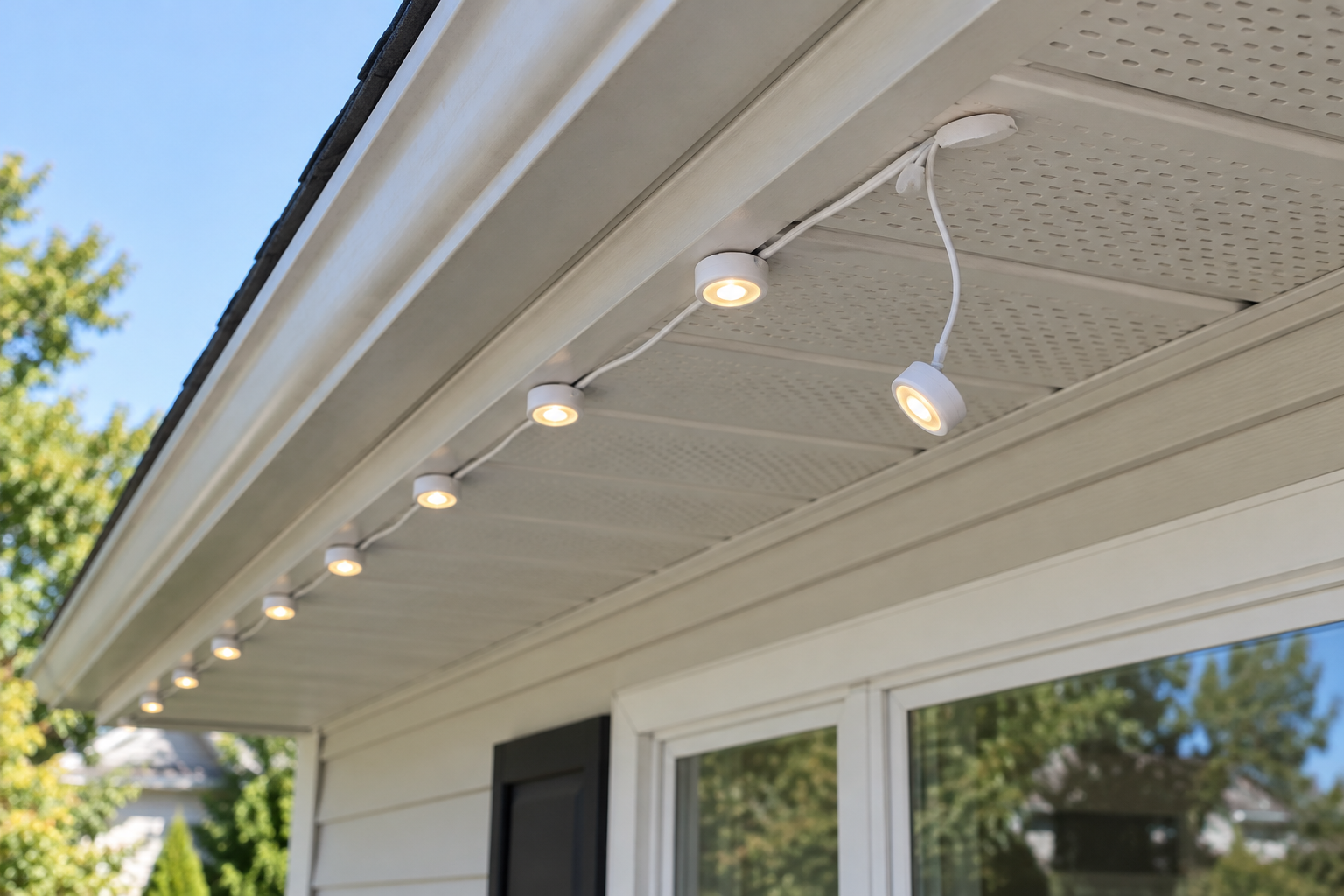
Retail puck-light kits are often installed without tracks, leaving individual light points and connecting wires exposed. An adhesive foam pad may look tidy on installation day, but adhesive-only mounting can loosen as surfaces expand and contract through hot summers and cold winters. Surface preparation, moisture and the mounting surface also matter. A loose puck can leave a sagging wire and strain a connection.
Ask whether the installation relies on adhesive alone. Govee supplies adhesive and clips on specified models and instructs installers to use both. Missing that mechanical support leaves the installation incomplete. Check the exact model’s manufacturer mounting instructions.
Exposed Wiring
Concealed Wiring
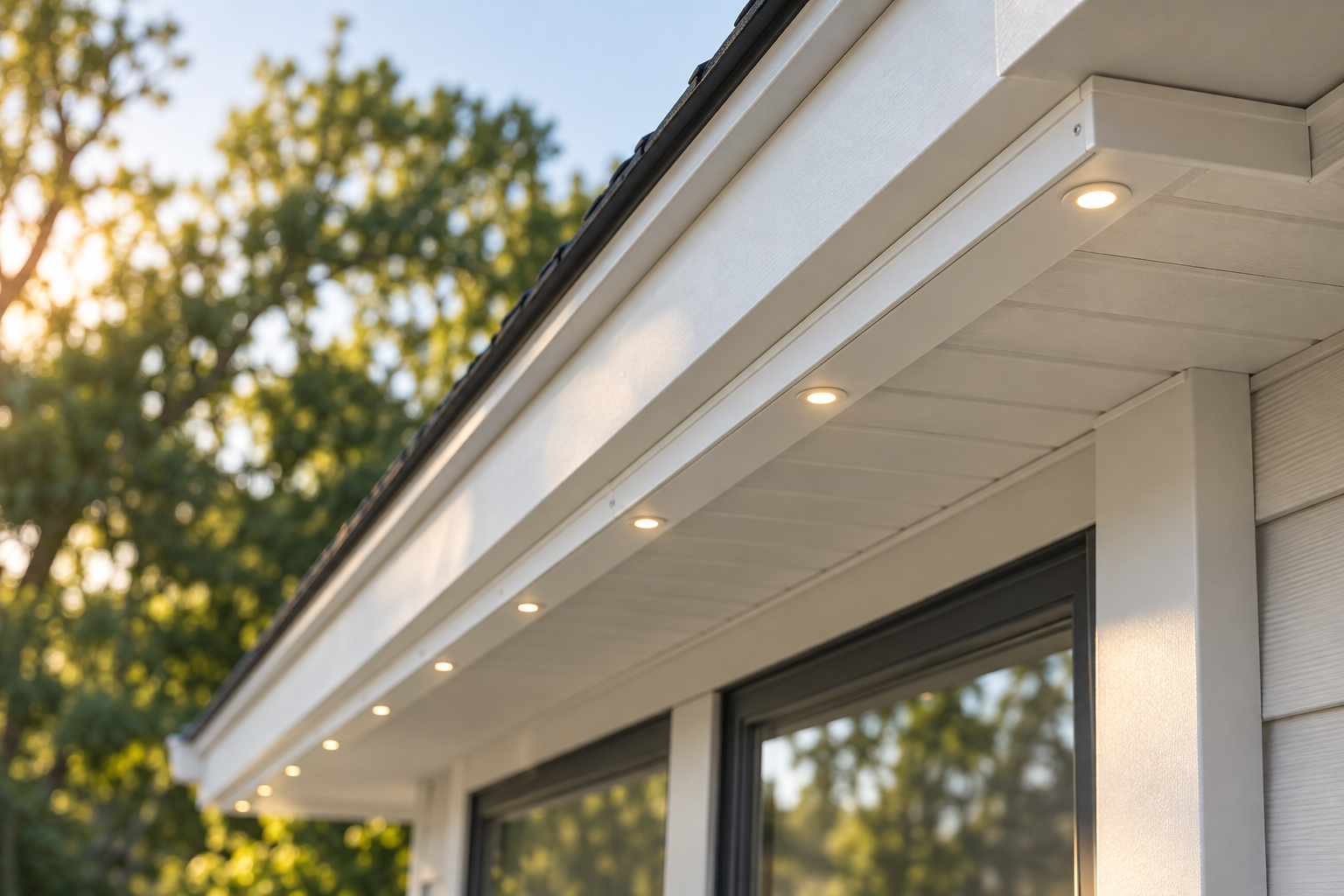
We supply permanent lighting in low-profile aluminum tracks that conceal wiring beneath appropriate eaves or soffits. Track placement and finish are discussed for the home. Ask to see daylight details when comparing proposals; a dramatic night photo can hide an untidy installation.
What Can Turn A Cheap Kit Into An Expensive Installation?
| What matters | Retail / DIY concerns to question | What to expect from a professional |
|---|---|---|
| Roofline fit | Fixed spacing and model-specific cut or extension limits can leave awkward gaps or unwanted lit sections. Who has checked your exact layout? | A planned route for peaks, corners and unlit transitions, within the system’s specifications. |
| Mounting & temperature changes | Adhesive-only attachment can loosen through weather and temperature changes. Are the required clips or other mechanical supports actually included? | A specified mounting method and securely fastened track—not a plan that depends on foam pads alone. |
| Exposed wiring & daylight appearance | Without a channel, wiring stays visible. Unsupported spans can sag or strain connections if a light comes loose. | Concealed wiring in low-profile aluminum tracks, with clean corners and supported transitions. |
| Cuts, splices & terminations | Non-cuttable sets cannot simply be trimmed to fit. Unauthorized cuts may affect warranty coverage; unsealed splices and ends can admit moisture and corrode. | A system-approved layout, permitted cuts only, and compatible sealed connections and end caps. Ask to see how transitions are protected. |
| One failed light | If individual pucks cannot be serviced, one fault may mean replacing a full strand. If compatible parts are unavailable, the entire kit may need replacement. | A clear explanation of what can be repaired, the replacement parts available and how service will be handled. |
| Troubleshooting & ladder work | Manufacturer support may leave you testing components, removing a strand or arranging another paid visit. Who returns to the roof? | A named local service contact, a diagnosis process and written terms for labor and access costs. |
| Warranty responsibility | A product replacement warranty may not pay for diagnosis, removal or reinstallation. A verbal promise leaves important questions unanswered. | Written coverage naming the responsible company, duration, exclusions and any service charges. |
| Company & insurance | A retail purchase proves nothing about the installer’s business identity or insurance. Missing proof is a separate red flag. | Verify the legal business name and current liability insurance before hiring; confirm who stands behind the work. |
| Long-term value | The shelf price leaves out mounting accessories, access equipment, repeat labor and possible strand or kit replacement. | Compare the completed installation and realistic service costs—not just the initial price per foot. |
Do not assume a higher quote guarantees these standards. Ask the installer to document them. Retail models vary, and the concerns above depend on the equipment and how it is installed.
Let’s plan your permanent lighting.
App Features Don’t Replace Installation Quality
Many consumer systems have capable apps. Professional equipment should also be evaluated on its actual features rather than assumed to do more. Request a demonstration of white light, brightness, schedules, zones and any integrations you care about.
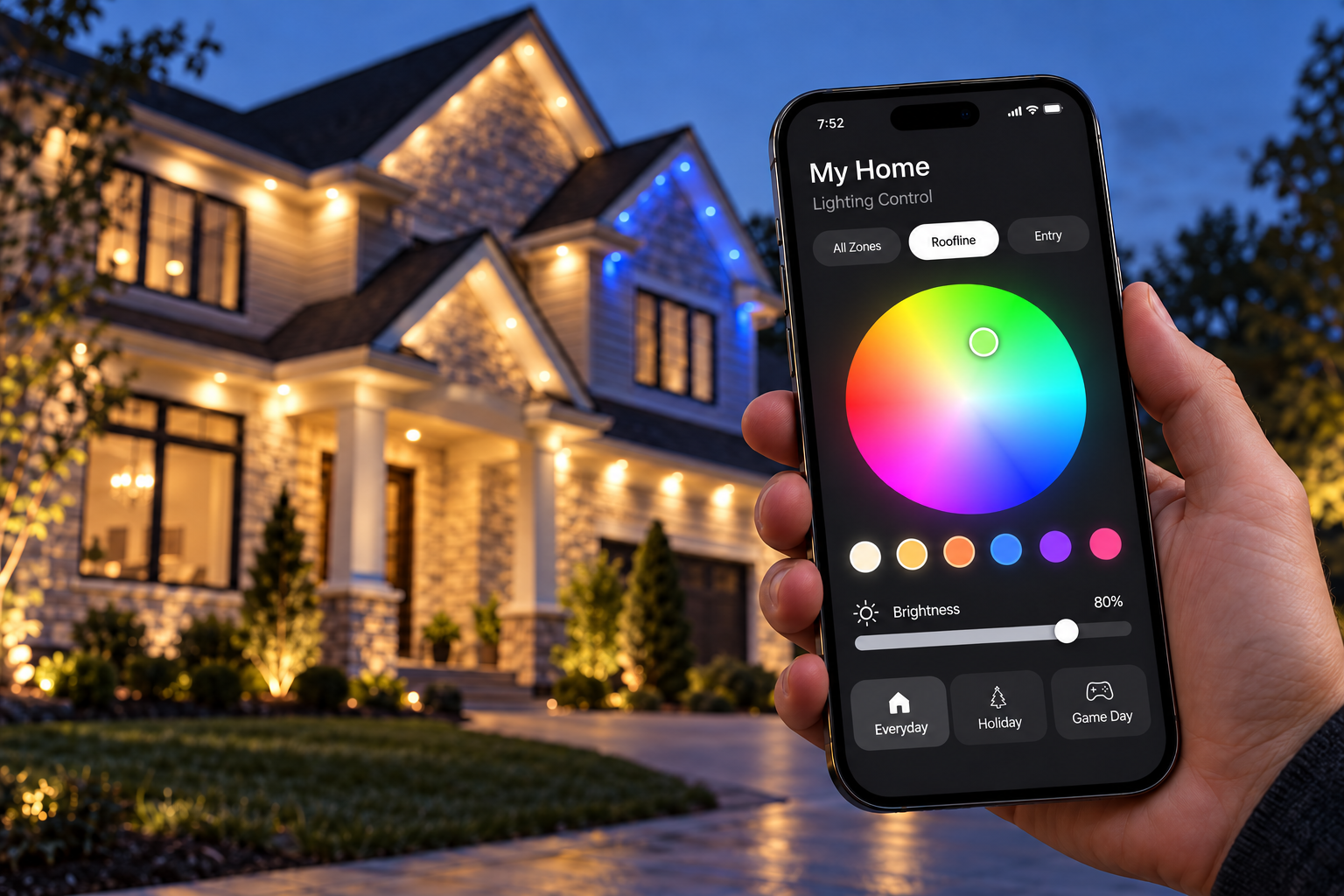
Also ask what happens after a power interruption or a lost internet connection. Which schedules continue? How do you recover control? Those answers are system-specific, and they matter more in everyday use than an impressive list of effects.
Read The Warranty As Carefully As The Feature List
Separate product coverage from installation labor. A replacement light shipped to your door is different from a technician diagnosing and repairing a high roofline. Ask whether a single failed light can be replaced, whether a whole strand must come down, and what happens if that model or its compatible parts are no longer available. A low upfront price can lose its appeal when repair means another installation project.
Get the service plan in writing: who diagnoses the fault, who obtains parts, who returns to the property, and whether removal, replacement and reinstallation labor are covered. Ask what you will pay after coverage ends.
The Real Houselights of NJ offers a three-year warranty with its permanent lighting installation; the proposal defines coverage. Do not infer that every component, damage scenario or later modification is included without checking those terms.
A Retail Kit In A Professional Quote Deserves A Closer Look
Off-the-shelf products may be appropriate for a weekend DIY project. They are not the standard we choose for a professionally supplied permanent-lighting installation. If a “company” is charging for a premium system while supplying a consumer retail kit, ask exactly what makes its offering worth that price.
- Verify the company: get its legal business name, contact information and a written scope of work. Know who you are actually hiring.
- Verify insurance: request proof of current liability insurance before work begins. A logo, social-media page or verbal assurance is not a substitute.
- Identify who honors the warranty: the written terms should name the responsible company and explain the claim process, covered parts, labor and exclusions.
- Ask for evidence of the finish: request close-up daylight photos of completed installations, including corners, wiring and mounting.
If an installer cannot provide these basics, treat that as a red flag. A warranty promise offers little reassurance if you cannot identify or reach the company behind it. The use of a retail kit alone does not establish whether an installer is insured or legitimate; the missing documentation and unclear responsibility are what should give you pause.
Common Questions
Will you install my Govee or big-box kit?
No. We supply and professionally install our own permanent lighting systems. We do not install customer-supplied retail permanent lighting kits.
Are all retail lights low quality?
No. Materials, output, controls and warranties vary. Compare the specific product and installation method against what you want for your house.
Why can’t quotes be compared only by price per foot?
Roof height, access, transitions, power, tracks and zones all affect the work. Equal footage can represent very different projects. Ask for the same coverage and service scope before comparing totals.
A Lighting Plan For Your North Jersey Home
The Real Houselights of NJ serves Bergen, Passaic, Essex and Morris counties, plus Rockland County, NY. Tell us what you want to light, the areas you use most, and your project budget. We’ll review your priorities and recommend a practical design for your property.
Start with your ideas. Build around your budget.